In our interview, the French DJ and producer Marine Tordjemann told us that she documents the fragments of her dreams, which can serve as the “compositional seeds” of her music. Her newest album as OKO DJ, As Above, So Below, flows with its own hallucinatory logic. The record is anchored by Tordjemann’s vocals, which switch from spoken to sung, raw to processed, and float over a bed of jazzy, dubby music that evades simple diagnosis. Our conversation with Tordjemann gets into the spiritual—and serendipitous—dimension of the album, her work as a DJ, production methods, and a whole lot more. Give it a read, and while you are at it, listen to As Above, So Below, if you haven’t already, which is also right under this text.
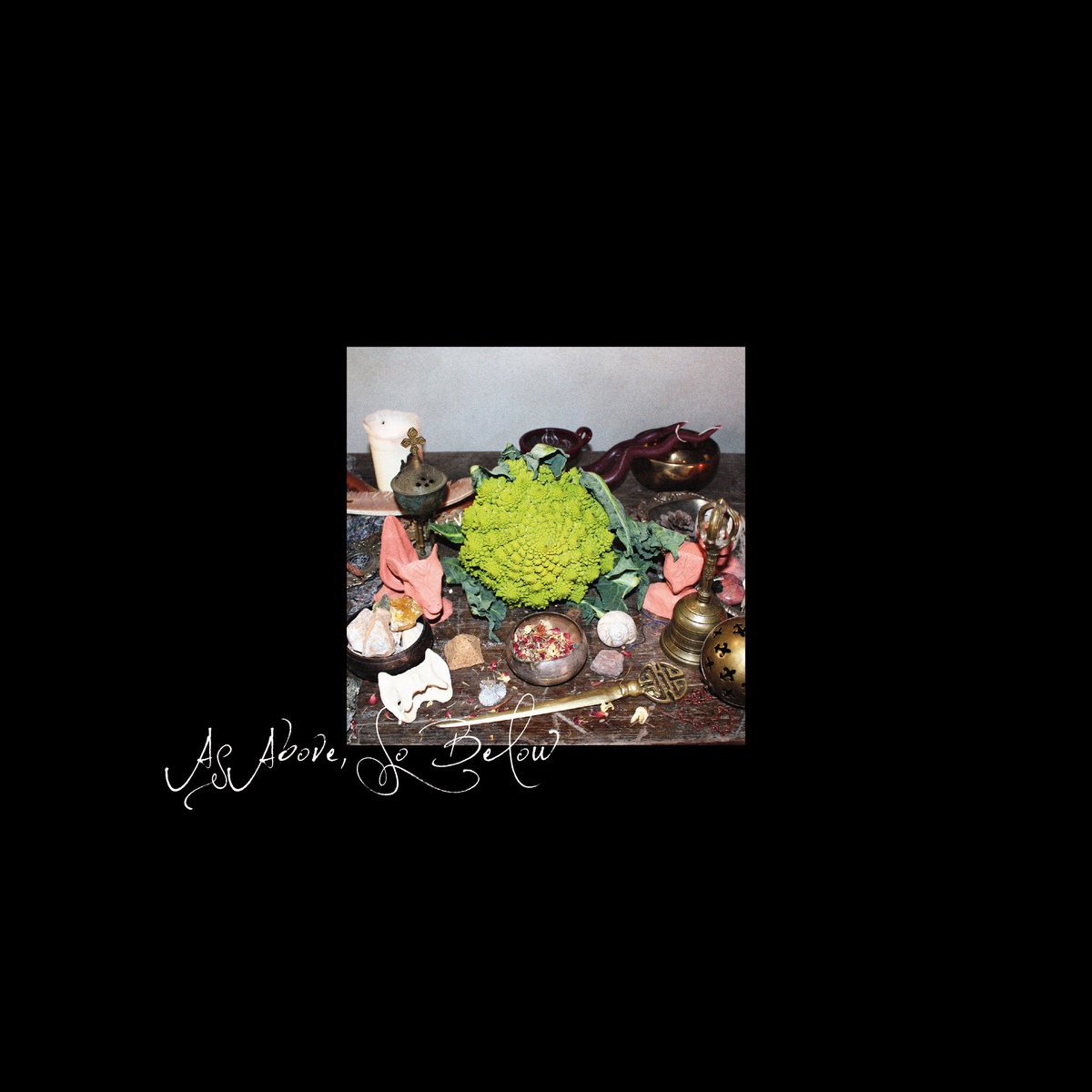
OKO DJ - As Above, So Below
Q&AAn expansive chat with the French DJ and producer.
By editorial
2026/03/30
- 1Exolition
- 2La Colline au Ciel
- 3είμαι ή δεν είμαι (feat. onarrivenow)
- 4Formentera (feat. lux18)
- 5Je suis la Terre qui absorbe Dieu (feat. onarrivenow)
- 6Ivres
- 7Erotic Love Triangle
- 8Parfois, Dans la Lumière... (feat. Eiger Drums Propaganda)
Is there a spiritual dimension to this new record? How is that tied to your own experience with spirituality?
OKO DJ: Yes. The title As Above, So Below is the structural and spiritual axis of the record. The phrase refers to the Hermetic principle of correspondence: macrocosm and microcosm reflect each other; inner states mirror outer reality. That idea resonates with ancient esoteric teachings and sacred geometry—symmetry, fractals, repeating proportional systems. The album is constructed according to that logic: patterns recur at different scales, rhythms mirror melodic contours, micro-textures reflect macro-structures. The title did not emerge analytically. It came during an epiphany—a sudden cognitive clarity rather than a gradual decision. One week later, I experienced confirmation through synchronicity.
Before leaving for a tour in Hong Kong and China, my friend Camille lent me a book: Visage du vent d’est by Kenneth White. After my show in Hong Kong, jet-lagged and unable to sleep, I began reading. The narrator was also in Hong Kong. Within the first pages, the sentence appeared: “As above, so below.” The convergence of place, timing, and text was immediate. I was physically in Hong Kong, reading a narrative set in Hong Kong, and encountering the exact phrase that had surfaced internally days before. The alignment felt precise. That moment fixed the title definitively. Besides, my zazen practice informs how I relate to spirituality within the work. Zazen emphasizes posture, breath, and observation of transient phenomena without attachment. That discipline shapes the pacing of the album: restraint, repetition, suspension. Silence is treated as structure, not absence.
Ancient teachings provide the conceptual frame; meditation provides perceptual training; personal dreams provide imagery. I record dream fragments immediately upon waking—symbolic scenes, distortions of scale, architectural impossibilities. These become compositional seeds. The record integrates contemplative practice, metaphysical structure, and subconscious narrative. Spirituality here is structural alignment between perception and form.
How does your work as a DJ and record collector inform how you make tracks?
My background as a DJ and record collector mostly shaped my listening rather than the intention behind my productions. Spending years digging and playing music gives you an extremely wide sonic spectrum—different eras, scenes, production methods, emotional registers. That inevitably filters into how I hear and assemble sound. But when I produce, I don’t think about genre, functionality, or the dancefloor. The music isn’t designed to fit a context. It’s simply the result of a state I’m moving through at a given moment. A track emerges from a feeling, an image, or a texture I want to explore, not from the idea of matching a scene or aesthetic. So the DJ experience provides a deep reservoir of references and listening habits, but the act of composing itself is intuitive and inward-facing.
Another production question: What is your current favorite way to make a weird little noise?
Recording small acoustic sounds—metal friction, breath, paper, room tone—and then stretching them, pitching them down, sometimes granulating them or adding a touch of saturation. Very small sources can turn into unstable atmospheres. I tend to prefer these imperfect, accidental textures over synthetic presets. For example, on “Ivres” there is a kind of “missed flute” sound. I was trying to record a clean tone with a flûte traversière, but I accidentally produced this strange, broken note. It already sounded a bit unusual on its own, so I didn’t need to process it much. What I liked is that the sound sits somewhere between a breath and a percussion hit—almost percussive, but still airy. I kept it, stretched it slightly, and eventually it became almost unrecognizable as a flute. The entire track was built around that single accidental sound that resonated with me.
At what point in the process do lyrics start to come into the mix? Are they responding to music or can it be the other way around?
Most often, music precedes text. Harmonic and rhythmic structures define emotional temperature first. Lyrics then respond to cadence and tonal density. However, independent textual fragments exist prior to composition—phrases from notebooks, mostly dream transcriptions, and isolated sentences that stay with me. Occasionally, one fragment dictates the musical direction. The relationship is bidirectional, but rhythm generally leads.
What is the ideal setting to listen to As Above, So Below?
Probably late at night, alone, with headphones and very little light—the kind of moment where you can really sink into the details. But it can also work on a large sound system, where the low frequencies become physical and you can feel the sound moving through the room. I like the idea that the record can exist in both situations—something intimate and inward, but also something that can fill a space.
Could you talk a bit about the music videos?
The three videos—”Erotic Love Triangle,” “Formentera,” and “La Colline au Ciel”—were all directed by longtime friend, dawn label boss and filmmaker Hajj. I first shared a few themes and the kind of approach I wanted: something atmospheric, where the objective is immersion and perceptual suspension rather than narrative clarity, with the visual rhythm following the pacing of the music.
We talked about elements like landscape, bodies in space, natural textures—earth, stone, water—and gestures that feel almost ritualistic. I was interested in images that sit somewhere between intimacy and symbolism: physical presence, but also something slightly archetypal or suspended in time. After that, I sent him the full live recording of the album and gave him complete freedom. From there he built the visual world himself, translating those ideas through his own sensitivity. I like working like this—giving direction but leaving room for someone else’s imagination. It allows the work to open up and take on another layer beyond my own perspective.
How does your NTS show about dreams connect to your creative writing process for the record composition?
My show, The Twisted Dream Diary, operates as a parallel research space. It focuses on dream accounts, subconscious imagery, and non-linear storytelling. The format privileges ambiguity and suspended resolution. Every morning I start the day with the same ritual: I write down my dreams, note the day of my cycle, and do a short gratitude practice. That notebook has become a kind of daily archive of subconscious material, and it’s actually the core source for The Twisted Dream Diary. Many of the dream fragments I read on the show come directly from there. That practice also shaped how I approached the voice on the record. In the show, dream texts are spoken almost like private notes being read out loud—something intimate and slightly suspended. I wanted the voice on the album to sometimes carry that same quality, appearing almost like a trace drifting through the soundscape. At the same time, in some tracks the voice is very present and the choice of words is extremely deliberate on my side. So the voice moves between those two states: sometimes dissolving into atmosphere, sometimes standing clearly in the foreground—a bit like how fragments of a dream can either fade or suddenly become very vivid.
Who are some of your favorite French artists currently making music?
Eiger Drums Propaganda, and all his parallel aliases and experiments (mortimer dubaton, pilotwings, J-zbel) There’s this constant obsession with percussion as language, whether it leans industrial, ambient or club. His vocal range is also kind of unbelievable. His new project with Jacques Satre as Belzebuth GX has been blowing my mind lately.
Eiger Drums Propaganda. Jonquera: and all Guillaume Lespinasse’s other projects like Tera Octe or Adiciatz with Manon Nogier also feel very singular—different directions but the same strong artistic voice. Gargantuan Grief and Modern Collapse are fascinating in how they collide metal, bass music and extremely detailed sound design.
I also have to mention J-zbel (Eiger Drums Propaganda, Jonquera & Gargantuan Grief), who really push boundaries with their live sets—cowboycore, hardstyle, prog trance, metal, and completely ridiculous props, all colliding in a way that somehow works. It’s chaotic, theatrical, and incredibly coherent at the same time. It’s also refreshing to see artists who really don’t give a fuck about being cool. I know they’re preparing a new release, so stay tuned!!
Lux18—who collaborated with me on Formentera—is a brilliant producer; I loved his album on Body Motion. Officium, both solo and with Jonquera, builds very immersive sonic worlds. JS Donny creates soft-doom atmospheres—slow, heavy but intimate. Their project with Donna Candy is also great. I’d also recommend checking the whole Bamboo shows label, which consistently releases beautiful records.
Bamboo. Zulu—the album Scar left me speechless. Hajj makes these deep, hypnotic constructions with a strong sense of atmosphere and narrative pacing, and curates the excellent label Dawn. And finally Helen Island—beautiful restraint, a real sense of melody, almost teenage-emo in spirit. It’s fascinating how much creativity they manage to find inside such a minimal framework.