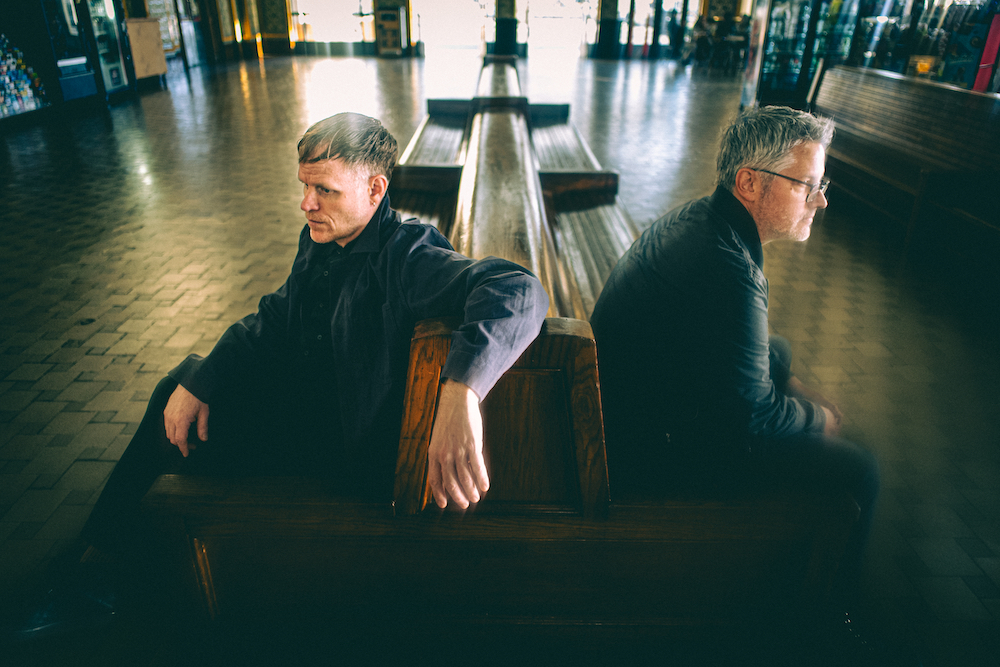
On Aris Kindt’s newest record, the duo’s first in eight years, sophisticated sound design is imbued with a sense of narrative tension. For the entire decade-plus run of the group, they have been as informed by process methodologies as the modernist and postmodernist literary canon; the music on Now Claims My Timid Heart continues this interest, pointing to various sonic traditions, drone and minimal techno among them, but never going too hard down any one path. Personally, I’m excited to take a long walk with the record when the weather gets very cold; its textures seem to lend themselves to an activity like that. We recently caught up with Francis Harris and Gabe Hedrick, where we went deep about those aforementioned literary influences, the group’s songwriting process, and much more. Read the piece and listen to the record below.
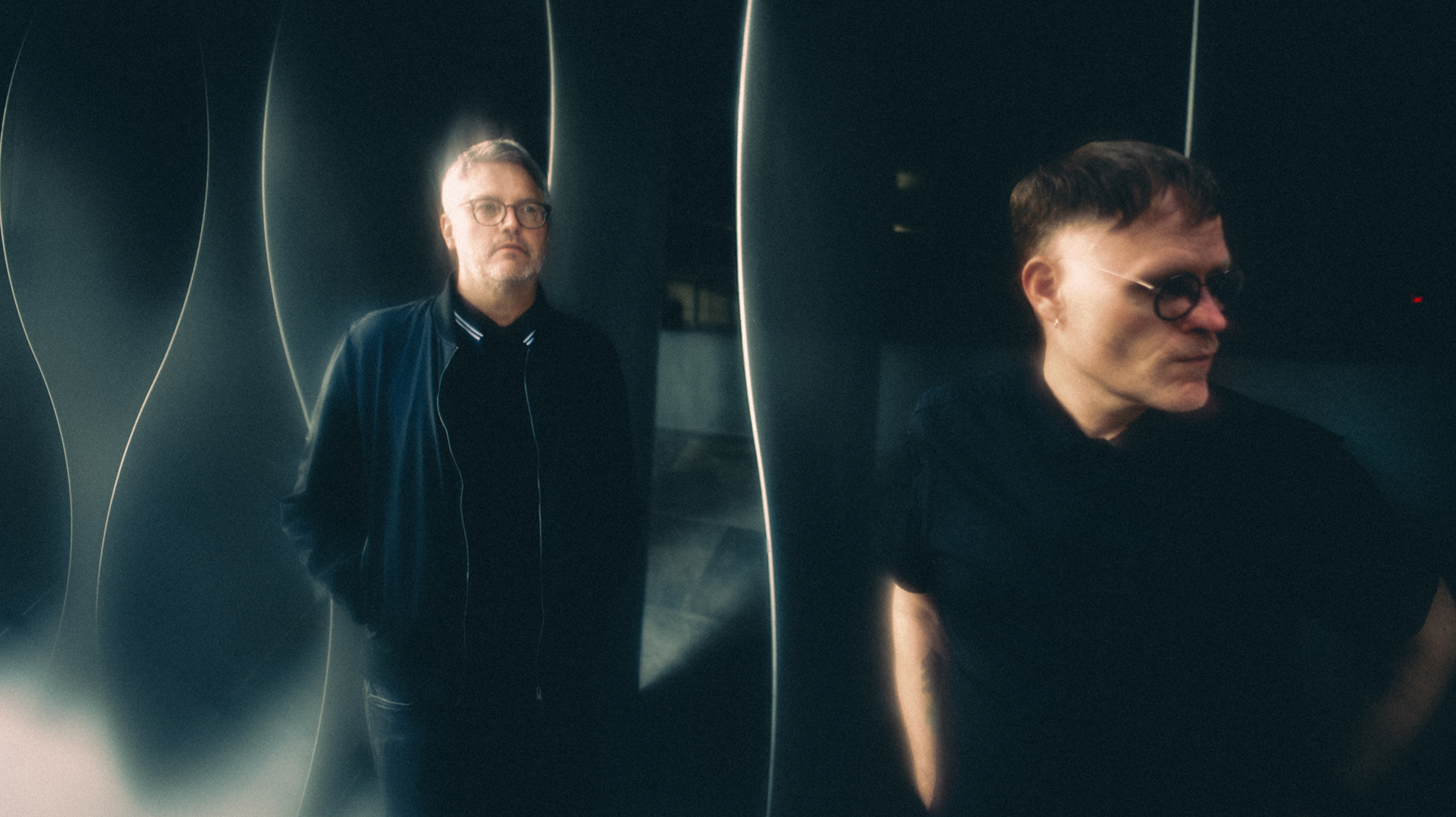
Aris Kindt - Now Claims My Timid Heart
Q&ATalking literary fiction and creative processes with the New York duo.
By JB Johnson
2025/12/08
- 1Saichh Sequences
- 2Now Claims My Timid Sight
- 3Shake Loose and Fall
- 4They Have the World Behind Them
- 5Time Measures
- 6Letters to Felice
- 7Alter
- 8Removal Plan
Could you talk a bit about some of the literary influences on this new record?
Francis: It's hard to pin down particular literary influences for any record as books play a part in most of our compositions. Aris Kindt as a project was born out of a particular passage from Sebald's Rings of Saturn in which he muses over Rembrandt's Anatomy Lesson of Dr. Nicolaes Tulp. The passage, a commentary on Rembrandt's use of inconsistencies to point back to a body that is made to disappear under a medical and penal gaze became a starting point for a conceptual project exploring the physicality of sound as a means of connecting the body to memory, effectively bringing Kindt back to life off the cold slab of reason.
While writing this LP in particular (most of the songs were started during the pandemic), I had gone down a Kafka rabbit hole and was particularly struck by a line from Letters to Felice where he writes: "You are at once the quiet and confusion of my heart." It encapsulated, as most of these letters did, the incessant push and pull between a conventional life and one of solitude and creation.
What are some strategies you used to represent those literary influences in a sonic form?
Francis: Nothing on the LP represents a straight line. Every sound takes a detour, is processed, re-processed, re-sampled, mangled, amplified, then filtered until all that's left is the ghost of that original sound. Mediation is a tool of the state apparatus. Nostalgia is a methodology of control. There are emotions inherent in these songs, but we sought to strip them back then rebuild them without falling back on musical tropes.
Gabe: When Francis sends me a new track, I'm not always aware of the inspiration. I think that's better. It's more freeing as a composer. I can listen to what he wrote and try to encapsulate the moods and textures that I hear without being boxed in by whatever concept he had in his head. I'm sure he'd say the same. The end result may even be completely different than what either of us had in mind at the outset, but that's kind of the beauty of collaboration. “They Have The World Behind Them” is a great example of the kind of pleasant surprises that come from collaborating in isolation. I sent Francis a melody I composed on the modular. A couple months later, he sent it back with the drums and bassline and had completely transformed it into something I would have never envisioned on my own. So much so that, even as I added some additional guitar elements, I hadn't recognized the original melody I composed until I was going through my Logic files and came across the original track months later. Of course, that could also just be me getting old and forgetful.
What’s your favorite way to collect sounds?
Francis: I have a Zoom field recorder that's been used more than just about anything I own but recently, I picked up a Torso Electronics S-4 Sculpting Sampler. I used it to process the field recordings and other samples to create convolution reverb rooms used throughout the record.
Gabe: I don't collect sounds at all. I'm usually just grabbing something random online or resampling something one of us already recorded. I'll then run it through my Make Noise Morphagene module and mangle it as much as I can so that it sounds almost nothing like the original. As with anything on the modular, though, it's pretty ephemeral, and once I've done what I've wanted to do with it, I'm recording over it with something else. I'm pretty sure “Saichh Sequences” includes a sample of a tiny snippet of one of our own tracks from Floods that I then processed into something completely unrecognizable using the Morphagene. I'll never be able to remember what it is though, because I eventually recorded over it with a new sample. This is both the blessing and the curse of composing on the modular—it's impossible to recreate later. There's something satisfying, though, about being able to create something singular and beautiful in that moment—never to be recreated.
If this record were a building, what would it look like?
Francis: The forest service building my father would take me to in Albuquerque, NM in the late 70s. It represents a momentary flash of idealism in my life. My father has since passed away (in 2010), as did my belief in governance.
Gabe: When I was a kid, my dad took me to this town in central Nevada called Goldfield to see my aunts who lived up there. It had been a boomtown in the early 20th century when they found gold in the surrounding areas. It has the distinction of hosting the longest heavyweight boxing title fight in history—42 rounds! It ended only on a technicality when one of the boxers was disqualified for a low blow. Anyway, when the gold dried up in the 1940s, the town slowly faded away. I think only a couple of hundred people live there now. One day, my dad and I were out walking through what was left of the town and stumbled on the old Goldfield High School that had been abandoned in the 1940s. The building was mostly brick, but anything that was made of wood had slowly rotted away after decades of 100 plus degree heat, including the stairs and floors. In hindsight, it probably wasn't the greatest idea to poke around. The rotted floors were covered with dusty, water-damaged old school books ... Shakespeare anthologies, old history books, etc., some of them published as far back as the late 1800s. My dad and I took a bunch of those older books back home with us to Las Vegas. I think this record is kind of like that building—like a faded memory of a time long gone
.
Tell us about the mixing process of Now Claims My Timid Heart.
Francis: As with all my records the mixing process really starts in the writing process. My setup is a hybrid between having a mixing console and a summing mixer. All the gear is connected via patchbay (including all fx, pedals, sampler, and outs from laptop). I have a refurbished 80s-era Studer 962 console so I rely heavily on EQs to get the feel I'm looking for, especially with overly processed effected guitar, synths and found samples. The kick and bass always runs through to mono DBX 160x compressors that help to shape their interplay, a crucial aspect considering how much focus is on the low end. Once the feeling is right, I did pre-mixes for reference for the final mix by summing eight stereo busses on the Studer. I then bounced each individual track through the console and brought them over to Sugar Mountain to mix with Phil Weinrobe. Once there, Phil did something similar. He mixed down to 4 stereo buses on his own Studer. But before, he did his magic cleaning up my mess with phasing issues from the FX processing and other things that only a brilliant mix engineer like Phil can do. We then ran the mixes through tape for extra saturation, giving the record an overall hazy feeling, much like the conceptual background for the project. In my mind, there are very few producers and mix engineers around as good as Phil.
What is the ideal context to listen to this record?
Francis: Not on Spotify.
Gabe: While watching Trump get carted off to a custom-built prison on Epstein's former private island with only a Bill Clinton body pillow to keep him warm.
Your band is named after a Rembrandt painting. What is the last great art exhibition you’ve seen?
Francis: Our band is actually named after the prisoner who is the subject of Rembrandt's painting, thus proving that he is still forgotten, just like I've forgotten what the last exhibition I’ve seen that was great, save for my annual visit to Serra's Torqued Spiral at Dia Beacon.
What’s the last great piece of music you’ve heard?
Francis: Yara Asmar—everyone I know is sleeping and I love them so so much.
Gabe: The new Tortoise record.
Photo Credit: Chad Kelco